
16 KiB
title, description, date, draft, tags, author, showToc
| title | description | date | draft | tags | author | showToc | |
|---|---|---|---|---|---|---|---|
| Binary Operations | 2025-02-17T08:37:24+00:00 | false |
|
TrudeEH | true |
Binary
Binary is a base-2 numeral system: A simple way to represent numbers using only two states.
| Binary | Decimal | Hexadecimal |
|---|---|---|
| 0000 | 00 | 00 |
| 0001 | 01 | 01 |
| 0010 | 02 | 02 |
| 0011 | 03 | 03 |
| 0100 | 04 | 04 |
| 0101 | 05 | 05 |
| 0110 | 06 | 06 |
| 0111 | 07 | 07 |
| 1000 | 08 | 08 |
| 1001 | 09 | 09 |
| 1010 | 10 | 0A |
| 1011 | 11 | 0B |
| 1100 | 12 | 0C |
| 1101 | 13 | 0D |
| 1110 | 14 | 0E |
| 1111 | 15 | 0F |

Speaking Binary
The information in this section is non-standard, and mostly a curiosity.
You may struggle to pronounce large binary numbers, as saying a long list of 0s and 1s is very inefficient. Instead, we can do something like this:

To be able to say any binary number, list the number, starting by the last digit:

And pronounce the ones that correspond to a 1 bit.

Pronounce a Binary Number at a Glance
-
Break the number at its largest pair of bits.

-
Represent the left and right sides.

In this example, there is a
twoin the order of magnitudehex. -
Continue to represent the left and right sides recursively.

The last number is
four.


Decode a Spoken Binary Number
Starting with two hex four:
-
Find the largest power of two.
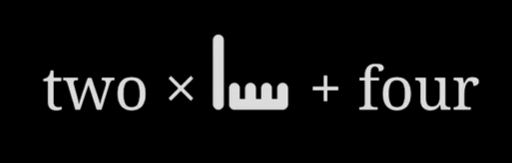
-
The number is equal to the left side, times the order of magnitude, plus the right side.



Avoiding Repetition
Repetition can be avoided by combining some very common, small numbers:


These shortcuts essentially create a quaternary system to pronounce binary, but in this case, the result improves spoken efficiency by a lot.
Arithmetic Operations
Addition
Adding two numbers can be done using a simple, manual algorithm: By adding the last bit of both numbers first, carry if necessary, then move on to the next number, and so on.
| + | 0 | 1 |
|---|---|---|
| 0 | 0 | 1 |
| 1 | 1 | 10 |

To add numbers more efficiently by hand, you can group bits together and memorize the patters, effectively doubling your speed.
To improve calculation speed even further, you can group more bits, and learn those patterns as well.


Half Adder
Add 2, single-digit binary numbers.
| A | B | Carry | Sum |
|---|---|---|---|
| 0 | 0 | 0 | 0 |
| 0 | 1 | 0 | 1 |
| 1 | 0 | 0 | 1 |
| 1 | 1 | 1 | 0 |
!
Full Adder
When adding 2 binary numbers, one operation might return a carry value, which the half adder can't accept, as it only has 2 inputs.
!
To solve this issue, a full adder accepts 3 inputs.
!
8-Bit Adder
!
Subtraction
Subtraction can result in negative numbers. Like how additions need a carry, subtraction needs a borrow.
Half Subtractor
Subtract 2, single-digit binary numbers.
| A | B | Diff | Borrow |
|---|---|---|---|
| 0 | 0 | 0 | 0 |
| 0 | 1 | 1 | 1 |
| 1 | 0 | 1 | 0 |
| 1 | 1 | 0 | 0 |
!
Full Subtractor
A full subtractor accepts the borrow value, allowing us to chain results.
| A | B | Bin | Diff | Bout |
|---|---|---|---|---|
| 0 | 0 | 0 | 0 | 0 |
| 0 | 0 | 1 | 1 | 1 |
| 0 | 1 | 0 | 1 | 1 |
| 0 | 1 | 1 | 0 | 1 |
| 1 | 0 | 0 | 1 | 0 |
| 1 | 0 | 1 | 0 | 0 |
| 1 | 1 | 0 | 0 | 0 |
| 1 | 1 | 1 | 1 | 1 |
!
8-Bit Subtractor
!
Multiplication
Multiplication is also similar to its decimal counterpart, but because binary is so small compared to decimal, the steps are also much simpler.
First, multiply the top number to every digit of the bottom one, and then add the results together.
| X | 0 | 1 |
|---|---|---|
| 0 | 0 | 0 |
| 1 | 0 | 1 |
    ||.|
 x  ||.
    ....
   ||.|
+ ||.|
 |..|||.
2-Bit By 2-Bit Multiplier
!
Division
-
Find the smallest part of the dividend greater than or equal to the ==divisor==.
|.| ||..| -
Write the first digit of ==the answer==, and ==copy the original divisor down==.
| |.| ||..| |.| -
Subtract ==the aligned dividend digits== by ==the digits under the dividend==.
| |.| ||..| |.| | -
Lower ==the next dividend digit==.
| |.| ||..| |.| |. -
Is ==the total== greater or equal to the ==divisor==? If so, add a
1to the answer. If not, ==add a== ==0== ==to the answer== ==and return to step 4==.|. |.| ||..| |.| |. -
Return to step 2, until you reach the end of the number. If you reached the end, you found ==the answer==.
			 |.|
|.|  ||..|
		 |.|
			 |.|
			 |.|
				 .
ASCII
Binary can also be used to represent characters.
| Dec | Hex | Binary | HTML | Char | Description |
|---|---|---|---|---|---|
| 0 | 00 | 00000000 | � |
NUL | Null |
| 1 | 01 | 00000001 |  |
SOH | Start of Heading |
| 2 | 02 | 00000010 |  |
STX | Start of Text |
| 3 | 03 | 00000011 |  |
ETX | End of Text |
| 4 | 04 | 00000100 |  |
EOT | End of Transmission |
| 5 | 05 | 00000101 |  |
ENQ | Enquiry |
| 6 | 06 | 00000110 |  |
ACK | Acknowledge |
| 7 | 07 | 00000111 |  |
BEL | Bell |
| 8 | 08 | 00001000 |  |
BS | Backspace |
| 9 | 09 | 00001001 | 	 |
HT | Horizontal Tab |
| 10 | 0A | 00001010 | |
LF | Line Feed |
| 11 | 0B | 00001011 |  |
VT | Vertical Tab |
| 12 | 0C | 00001100 |  |
FF | Form Feed |
| 13 | 0D | 00001101 | |
CR | Carriage Return |
| 14 | 0E | 00001110 |  |
SO | Shift Out |
| 15 | 0F | 00001111 |  |
SI | Shift In |
| 16 | 10 | 00010000 |  |
DLE | Data Link Escape |
| 17 | 11 | 00010001 |  |
DC1 | Device Control 1 |
| 18 | 12 | 00010010 |  |
DC2 | Device Control 2 |
| 19 | 13 | 00010011 |  |
DC3 | Device Control 3 |
| 20 | 14 | 00010100 |  |
DC4 | Device Control 4 |
| 21 | 15 | 00010101 |  |
NAK | Negative Acknowledge |
| 22 | 16 | 00010110 |  |
SYN | Synchronize |
| 23 | 17 | 00010111 |  |
ETB | End of Transmission Block |
| 24 | 18 | 00011000 |  |
CAN | Cancel |
| 25 | 19 | 00011001 |  |
EM | End of Medium |
| 26 | 1A | 00011010 |  |
SUB | Substitute |
| 27 | 1B | 00011011 |  |
ESC | Escape |
| 28 | 1C | 00011100 |  |
FS | File Separator |
| 29 | 1D | 00011101 |  |
GS | Group Separator |
| 30 | 1E | 00011110 |  |
RS | Record Separator |
| 31 | 1F | 00011111 |  |
US | Unit Separator |
| 32 | 20 | 00100000 |   |
space | Space |
| 33 | 21 | 00100001 | ! |
! | exclamation mark |
| 34 | 22 | 00100010 | " |
" | double quote |
| 35 | 23 | 00100011 | # |
# | number |
| 36 | 24 | 00100100 | $ |
$ | dollar |
| 37 | 25 | 00100101 | % |
% | percent |
| 38 | 26 | 00100110 | & |
& | ampersand |
| 39 | 27 | 00100111 | ' |
' | single quote |
| 40 | 28 | 00101000 | ( |
( | left parenthesis |
| 41 | 29 | 00101001 | ) |
) | right parenthesis |
| 42 | 2A | 00101010 | * |
* | asterisk |
| 43 | 2B | 00101011 | + |
+ | plus |
| 44 | 2C | 00101100 | , |
, | comma |
| 45 | 2D | 00101101 | - |
- | minus |
| 46 | 2E | 00101110 | . |
. | period |
| 47 | 2F | 00101111 | / |
/ | slash |
| 48 | 30 | 00110000 | 0 |
0 | zero |
| 49 | 31 | 00110001 | 1 |
1 | one |
| 50 | 32 | 00110010 | 2 |
2 | two |
| 51 | 33 | 00110011 | 3 |
3 | three |
| 52 | 34 | 00110100 | 4 |
4 | four |
| 53 | 35 | 00110101 | 5 |
5 | five |
| 54 | 36 | 00110110 | 6 |
6 | six |
| 55 | 37 | 00110111 | 7 |
7 | seven |
| 56 | 38 | 00111000 | 8 |
8 | eight |
| 57 | 39 | 00111001 | 9 |
9 | nine |
| 58 | 3A | 00111010 | : |
: | colon |
| 59 | 3B | 00111011 | ; |
; | semicolon |
| 60 | 3C | 00111100 | < |
< | less than |
| 61 | 3D | 00111101 | = |
= | equality sign |
| 62 | 3E | 00111110 | > |
> | greater than |
| 63 | 3F | 00111111 | ? |
? | question mark |
| 64 | 40 | 01000000 | @ |
@ | at sign |
| 65 | 41 | 01000001 | A |
A | |
| 66 | 42 | 01000010 | B |
B | |
| 67 | 43 | 01000011 | C |
C | |
| 68 | 44 | 01000100 | D |
D | |
| 69 | 45 | 01000101 | E |
E | |
| 70 | 46 | 01000110 | F |
F | |
| 71 | 47 | 01000111 | G |
G | |
| 72 | 48 | 01001000 | H |
H | |
| 73 | 49 | 01001001 | I |
I | |
| 74 | 4A | 01001010 | J |
J | |
| 75 | 4B | 01001011 | K |
K | |
| 76 | 4C | 01001100 | L |
L | |
| 77 | 4D | 01001101 | M |
M | |
| 78 | 4E | 01001110 | N |
N | |
| 79 | 4F | 01001111 | O |
O | |
| 80 | 50 | 01010000 | P |
P | |
| 81 | 51 | 01010001 | Q |
Q | |
| 82 | 52 | 01010010 | R |
R | |
| 83 | 53 | 01010011 | S |
S | |
| 84 | 54 | 01010100 | T |
T | |
| 85 | 55 | 01010101 | U |
U | |
| 86 | 56 | 01010110 | V |
V | |
| 87 | 57 | 01010111 | W |
W | |
| 88 | 58 | 01011000 | X |
X | |
| 89 | 59 | 01011001 | Y |
Y | |
| 90 | 5A | 01011010 | Z |
Z | |
| 91 | 5B | 01011011 | [ |
[ | left square bracket |
| 92 | 5C | 01011100 | \ |
|backslash | |
| 93 | 5D | 01011101 | ] |
] | right square bracket |
| 94 | 5E | 01011110 | ^ |
^ | caret / circumflex |
| 95 | 5F | 01011111 | _ |
_ | underscore |
| 96 | 60 | 01100000 | ` |
` | grave / accent |
| 97 | 61 | 01100001 | a |
a | |
| 98 | 62 | 01100010 | b |
b | |
| 99 | 63 | 01100011 | c |
c | |
| 100 | 64 | 01100100 | d |
d | |
| 101 | 65 | 01100101 | e |
e | |
| 102 | 66 | 01100110 | f |
f | |
| 103 | 67 | 01100111 | g |
g | |
| 104 | 68 | 01101000 | h |
h | |
| 105 | 69 | 01101001 | i |
i | |
| 106 | 6A | 01101010 | j |
j | |
| 107 | 6B | 01101011 | k |
k | |
| 108 | 6C | 01101100 | l |
l | |
| 109 | 6D | 01101101 | m |
m | |
| 110 | 6E | 01101110 | n |
n | |
| 111 | 6F | 01101111 | o |
o | |
| 112 | 70 | 01110000 | p |
p | |
| 113 | 71 | 01110001 | q |
q | |
| 114 | 72 | 01110010 | r |
r | |
| 115 | 73 | 01110011 | s |
s | |
| 116 | 74 | 01110100 | t |
t | |
| 117 | 75 | 01110101 | u |
u | |
| 118 | 76 | 01110110 | v |
v | |
| 119 | 77 | 01110111 | w |
w | |
| 120 | 78 | 01111000 | x |
x | |
| 121 | 79 | 01111001 | y |
y | |
| 122 | 7A | 01111010 | z |
z | |
| 123 | 7B | 01111011 | { |
{ | left curly bracket |
| 124 | 7C | 01111100 | | |
| | vertical bar |
| 125 | 7D | 01111101 | } |
} | right curly bracket |
| 126 | 7E | 01111110 | ~ |
~ | tilde |
| 127 | 7F | 01111111 |  |
DEL | delete |